

Key takeaways
- Safety, security, and dangerous goods training are organized by function, and each role needs its own mix of all three.
- The three disciplines rely on shared habits, such as spotting what looks out of place and reporting it promptly, so training them side by side strengthens each one.
- Regulators place responsibility for competence with the employer. That holds when an external provider delivers the training, and when staff move into a new role.
- The 68th edition of the IATA Dangerous Goods Regulations (DGR) takes effect on 1 January 2027, which makes the coming weeks a good time to review where each team stands.
Most airports, ground handlers, and cargo operators run their safety, security, and dangerous goods training as separate programs, each with its own schedule, targets and reporting. On the ground, though, whether it's catering to passengers and their bags or processing shipments, safety and security often rely on different teams all being adequately trained and working together.
No single check can cover the whole picture and each part of the process only works as well as the people in it. Training works best when it reflects that overlap, and when the organization can show that every person holds the right combination for their role.
Where the risk sits
In a white paper published in September 2026, the International Air Transport Association (IATA) reported that 81% of dangerous goods occurrences in the cargo supply chain between 1 January and 30 June 2025 involved undeclared or hidden items. Dangerous goods travel safely by air every day under established rules, and most of the exposure begins when an item enters the chain without a declaration, often because the sender doesn’t realize it is regulated.
The growth of e-commerce adds to the challenge, as more shipments now start with small sellers who have little to no experience of aviation rules.
How the three disciplines fit together
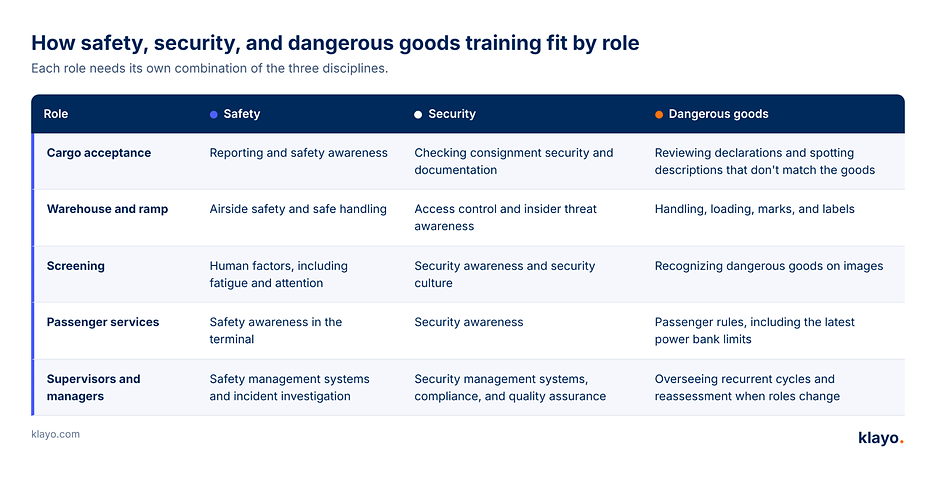
Safety, security, and dangerous goods training share a foundation: people who notice when something looks out of place and know who to tell.
- Human factors training helps staff understand how fatigue and routine affect what they notice.
- Security culture and dangerous goods training then give them something specific to look for and a clear way to raise it.
- Recognizing dangerous goods on an X-ray image is a skill of its own, and screeners need dedicated training to build it.
The right combination of skills depends on the role.
Who is accountable for competence
Dangerous goods training is organized by function, with each role learning the part of the rules it applies. The International Civil Aviation Organization (ICAO) requires recurrent training within 24 months of the previous training, and the rules keep moving between cycles. For example, in March 2026, ICAO amended its Technical Instructions to limit passengers to two power banks each and prohibit recharging them in flight, but the 68th edition of the DGR only takes effect on 1 January 2027.
Regulators are clear about where responsibility sits. In the UK, the Civil Aviation Authority (CAA) states that it is the employer’s responsibility to ensure personnel are competent, and that this responsibility “remains with the employer” even when a third party delivers the training. The CAA also requires that personnel assigned to new functions be assessed for competence in that function.
That second requirement matters most for teams that move people around to cover rosters. A ramp agent covering a shift at cargo acceptance needs to be competent for acceptance, and the responsibility lies with the employer who needs to be able to demonstrate proof of that competence.
This means that, for each person, supervisors and managers need to be able to see, accurately and in real-time, which functions they are trained and assessed for and when that training falls due under the current edition of the rules.
Safety and security training follow similar logic. Human factors, safety management systems, security culture, and insider threat awareness all depend on habits as much as on knowledge. Without regular refreshers, those can fade over time. Regular training is what keeps them active.
Keeping skills sharp and current
Training itself is only half the picture. Managers also need to see whether the knowledge in each team is current, which makes it a record management question as much as a training question.
Klayo allows you to manage both, in a single platform, designed for the airport and aviation industry. All courses are accredited by Airports Council International (ACI) and available on demand, which suits teams working rotating shifts.
- Dangerous goods: Two-hour, function-specific courses for each role in the chain. Ramp and warehouse teams can start with DGR 7.4, and screeners with DGR 7.10. For check-in and other passenger-facing staff, DGR 7.5 covers passenger handling.
- Safety: Airside safety training, certificate in Airside Safety I and II, plus courses on human factors, safety management systems, and incident investigation.
- Security: Recurrent training such as the Airport Security Officer Recurrent Training (ASORT) Program covers the key procedures and operational practices needed to support safe, consistent, and compliant security operations.
- Tracking competence: For teams that want to see who holds each competency and when it expires, Klayo’s workforce compliance tools link training to industry-standard roles, tasks and competencies to keep the records in one, always up-to-date place.
Planning your 2027 training cycle?
Explore accredited safety, security, and dangerous goods courses on Klayo.