
Key takeaways
- A 2025 meta-analysis found that, without practice, people lose half of their initial skill gains after only 6.5 months.
- At airports, the tasks most exposed are critical ones performed rarely which a certification cycle can leave unrefreshed for too long.
- Competent coverage, meaning how many people can perform each task on each shift, gives leadership a clearer view of operational risk than completion rates alone.
Training reports tend to only record one thing: has a training course been completed? Whether the skills behind it are still sharp 6 months down the line is a separate question and recent research suggests the answer depends far more on how often a task is performed than on when someone last completed a course.
As airports finalize their 2027 training plans, this distinction changes which tasks deserve the most attention and how often they need refreshing.
Skill decay: what the research says
In 2025, Psychological Bulletin published a meta-analysis bringing together research on how well people retain procedural skills over time. Its central finding is clear: without practice, people lost half of their initial performance gains after roughly 6.5 months on accuracy-based measures, and after around 13 months on speed-based ones (Psychological Bulletin, 2025). The review also identified how often people get the chance to perform a task as one of the factors shaping how quickly their skills fade.
Without practice, people lose half of their initial performance gains after roughly 6.5 months on accuracy-based measures, and after around 13 months on speed-based ones
The real-life effects of those findings for airports are pretty straight-forward: A procedure carried out every shift stays sharp because the work itself is the practice but a procedure carried out twice a year depends entirely on what the last training left behind, and six months is long enough for much of that to fade.
The impact on airports
Airports run on a large number of tasks performed every day, as well as a smaller set that are rarely called for but may be some of the most critical. Low visibility procedures, for example, may only be needed on a handful of nights each year and responses to irregular operations follow a similar pattern, as do tasks tied to equipment that is only used seasonally.
These are the tasks where a two- or three-year certification cycle can leave the widest gap between being qualified on paper and being ready in practice. They are also the tasks most likely to sit with one or two experienced people, which adds to the exposure whenever those people are on leave or move on.
High-reliability industries such as nuclear power and defence have long used a difficulty, importance, and frequency (DIF) analysis to find these tasks and rank their training priority, an approach set out in the US Department of Energy's handbook on systematic training (Korea Atomic Energy Research Institute, 2013). Tasks that are hard to learn and which carry a high-level of risk, yet rarely performed, are the ones daily work will never keep sharp. In a training plan, they deserve the most deliberate investment of all.
Tasks that are hard to learn and which carry a high-level of risk, yet rarely performed, are the ones daily work will never keep sharp
Four changes for your 2027 training plan
Set refresh dates by how often a task is performed
Certificate validity tells you when a regulator expects retraining but, as the research suggests, skills in rarely performed tasks can fade well before that date. For critical tasks performed monthly or less, a refresher or drill at least every six months is a reasonable starting point. Tasks performed every shift can be maintained through supervision and reassessed at the regulatory interval, which frees training time for the tasks that need it most.
Assess performance as well as completion
A completed course confirms someone has the knowledge but confirming they can apply it airside takes an observed, practical assessment. The International Civil Aviation Organization's (ICAO) competency-based training and assessment approach evaluates people against defined, observable standards of performance rather than hours spent in training.
Regulators appear to be moving in the same direction as demonstrated by the European Union Aviation Safety Agency (EASA) which recently proposed that operational control staff be trained and assessed against defined competencies rather than job titles.
Watch the time it takes for training to start
Decay only begins once a skill has been learned, and our own data suggests a larger gap often appears earlier. Across the Online Learning Centre's (OLC) hosted platforms in 2025, 16.4% of module-level enrolments had not started at the time of analysis, compared with 5.8% still in progress.
Training that begins usually gets finished, so the time between enrolment and a learner's first session is the earliest signal that a plan is slipping.
Report competent coverage
The most useful number in a 2027 training report is how many people are currently able to perform each critical task on each shift pattern, measured against the minimum the operation needs. It brings skill currency and rostering into one figure, and it is a number leadership can connect directly to operational risk.
The bigger picture
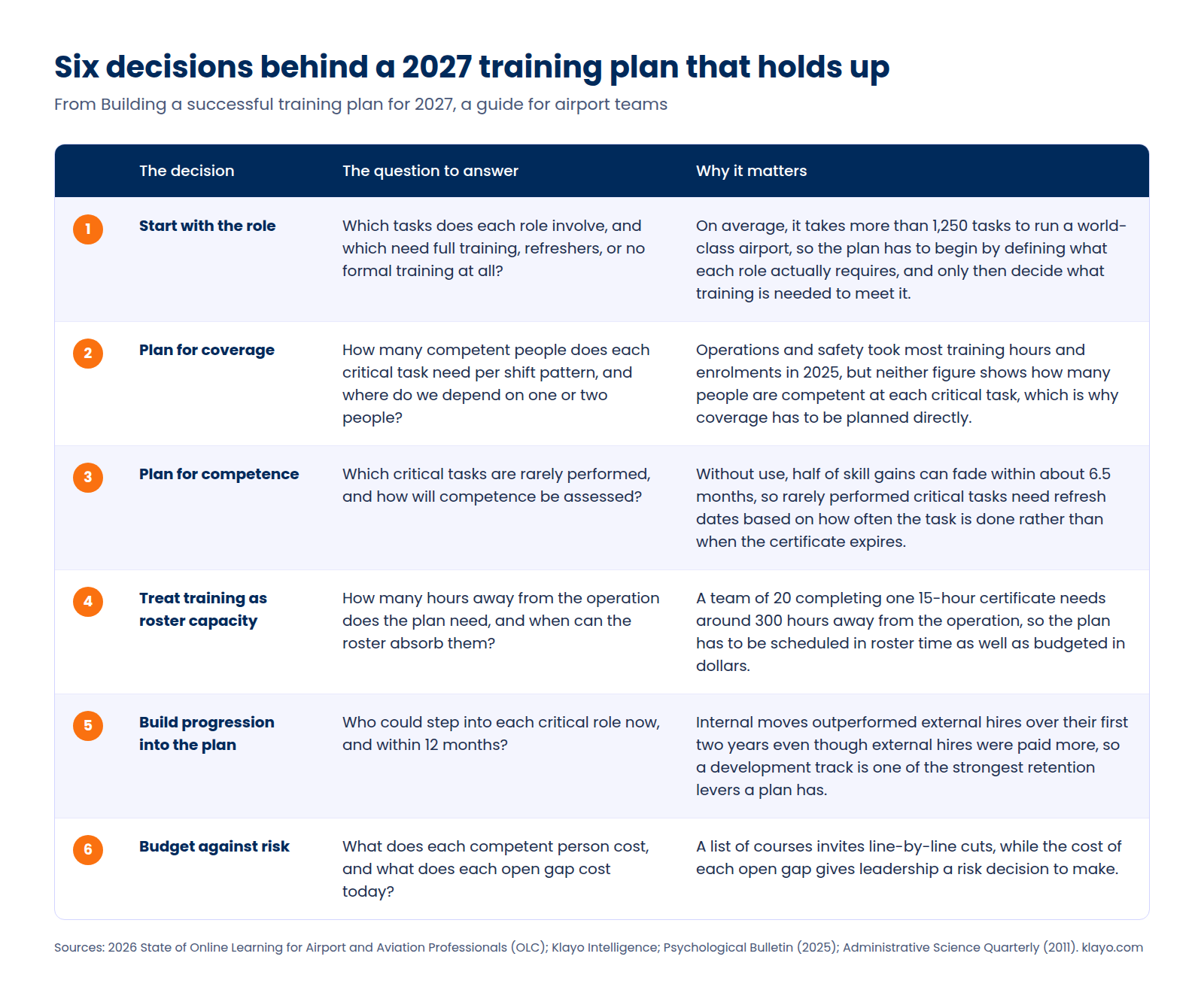
Planning for competence is one of six decisions explored in our new guide, Building a successful training plan for 2027. Drawing on our 2026 State of Online Learning report and peer-reviewed research, the guide sets out how to build a plan that leadership can read as both an operational risk strategy and a talent strategy.