
Key takeaways
- While aviation standardized its aircraft, procedures, and much of its training, job roles were never part of that work. Two airports can employ people under the same title performing measurably different work, with no shared reference point that would show the difference.
- Verified records of capability are moving into the hands of the individual, which makes the labour market legible in a way it has never been and changes what an airport's workforce data is actually for.
- Restricting movement does not produce loyalty. People stay longer where mobility is visible and possible, and an opportunity nobody can see behaves the same as no opportunity at all.
Aviation is a global industry by definition and most of its processes are standardized across regions and countries. There are some levels of variation but this standard approach is why an airline can land at an airport it has never used before and still reasonably expect the same set of rules and processes as anywhere else, why an aircraft is certified to a standard recognized across jurisdictions and why safety management systems follow a common structure.
This is one of aviation's real achievements that took decades of deliberate work to build. Unfortunately, the same can’t be said for one of the most critical components of any aviation operation or safety procedure: the workforce.
Job roles were never standardized. An airside operations officer at one airport and an airside operations officer at another can carry the exact same title but perform measurably different work and hold measurably different capability. There is no shared reference point that would reveal the difference.
With a talent shortage that encourages airport executives to look for staff outside of their usual perimeter, this lack of a shared language, creates even further challenges to recruiting and training the people needed for an airport to operate safely and efficiently.
Training got standardized but the roles it serves did not.
This distinction matters more than it first appears.
Consider training. Training, theoretical and practical, is an essential component of airport operations and it already works as a common currency. When a course is delivered against an internationally recognized standard, a completion means the same thing regardless of which airport the learner works at. The content, the assessment, and the standard are consistent. That is a genuine achievement, and it is why accredited training carries weight across the industry.
The difficulty is what sits around that completion. A course tells you what someone studied but it doesn’t tell you how relevant that information is to someone’s job. Completion reports also can’t tell you whether the training closed a genuine gap or if the acquired competencies will match the tasks that actually need to be done. Without an agreed description of the role, its scope of responsibilities, tasks and competencies, the training record floats free of any reference point that would give it operational meaning.
ACI World's own workforce guidance makes a version of this point, arguing that airports need a shared competency framework, often covering several hundred specific competencies, before training needs assessments can carry real meaning. Without that shared language, an airport ends up comparing training records that do not describe the same underlying skill.
Airports need a shared competency framework before training needs assessments can carry real meaning.
That guidance was originally aimed at conditions inside a single organization, where the same job title can mean different things across two departments.
The problem scales up considerably at industry level.
Two forces converging
The gap has existed for as long as the industry has and, until now, airports have found ways to work around it. Two things are making the workaround harder to sustain.
The first is purely arithmetic. Boeing projects commercial aviation will need around 2.4 million new personnel by 2045, and CAE puts the figure at 1,465,000 new professionals across the decade to 2034. These numbers already point to a very real challenge but they become even more concerning when you consider that neither forecast counts the security, terminal, airside, and ground handling roles that keep an airport running daily. Those roles and the skills they require are not aviation-specific and they often draw from labour pools shared with logistics, energy, and technology employers. When ground handling turnover runs as high as 50% annually, no amount of recruiting closes that gap.
The second is that capability is becoming portable. Deloitte's research finds that employers pursuing an employer-of-choice position are already experimenting with the concept of skills passports and moving the ownership of training and capability records into the hand of the individual instead of the organization.
According to the World Economic Forum, for this approach to work, three things are needed:
- consistent definitions across industries,
- portability that attaches the record to the person,
- credibility that comes from accredited verification.
Put those two together and the position of an individual airport changes. When professionals can carry credible evidence of their capability and read what a role elsewhere actually requires, the labour market becomes visible in a way it has never been.
Should airports hold tighter?
The obvious executive response is to hold tighter. Keep records internal, make “protect” their workforce against external poaching, and rely on an opaque market for retention.
The evidence shows us that this would be a mistake.
- LinkedIn data shows people stay 41% longer at organizations with high internal mobility, regardless of pay.
- Deloitte finds organizations with strong mobility retain people for 7.4 years on average against 4.1 years elsewhere.
- Fuel50's research found nearly a quarter of employees had never encountered the phrase "talent mobility" at all, which describes a specific failure: the opportunity may exist but nobody can see it.
An airport cannot show its own people a credible future while keeping their capability records closed and unreadable. The visibility that makes capability portable outward is the same visibility that makes internal movement possible.
An airport cannot show its own people a credible future while keeping their capability records closed and unreadable.
From retention to mobility
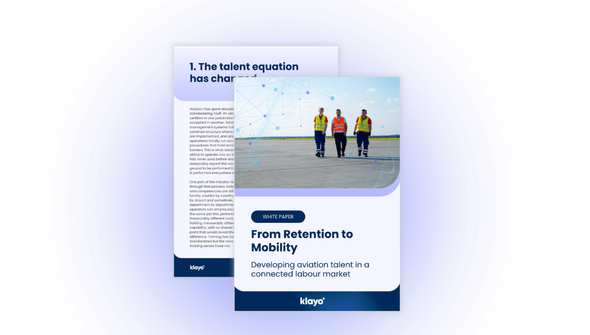
Offering a grounded view of how airports can develop aviation talent in an economy where that talent and their skills no longer belong to any single organization, our latest white paper From Retention to Mobility: Developing aviation talent in a connected labour market looks at what happens when the workforce finally joins the rest of aviation's standardized infrastructure.
It covers why training alone no longer settles the retention question, what portable capability records mean for airports specifically, and four practical changes for workforce teams working in a market they can suddenly see across.