
Key takeaways
- Strategic workforce planning should not be based on job descriptions but on the tasks people need to perform.
- Competencies connect each task to the training behind it. That keeps training spend aligned with what a role requires.
- People engage when they can see their own data. Top-down approaches have limited success without employee engagement.
Airports looking to gain an accurate view of their workforce should look past the roles themselves and, instead, look at the tasks people perform and the competencies behind them.
As we highlighted it in our recent webinar The evolving airport workforce, this concept leads to two critical questions that should sit behind any workforce plan:
- What knowledge and skills should your people have to perform their roles?
- What knowledge and skills do they currently have?
Answering the first takes job specifications detailed enough to be useful in daily operations, wherever they are kept, and answering the second takes training needs and capability assessments. As Eddie Ragauskas, Klayo’s CEO, puts it, an airport’s workforce capability only improves as each individual’s capability improves.
From people to training, through the tasks
At the centre of a strong workforce management plan are the people. Each person holds a job and each job breaks down into tasks that call for competencies, i.e. the knowledge, skills, and abilities needed to perform the jobs safely and effectively. Training is there to build those competencies, tying what people learn to what the role requires.
Unfortunately, people still tend to go straight from job to training and when a plan moves straight from a job to a course list, spending can land on training that does not match what the job needs.
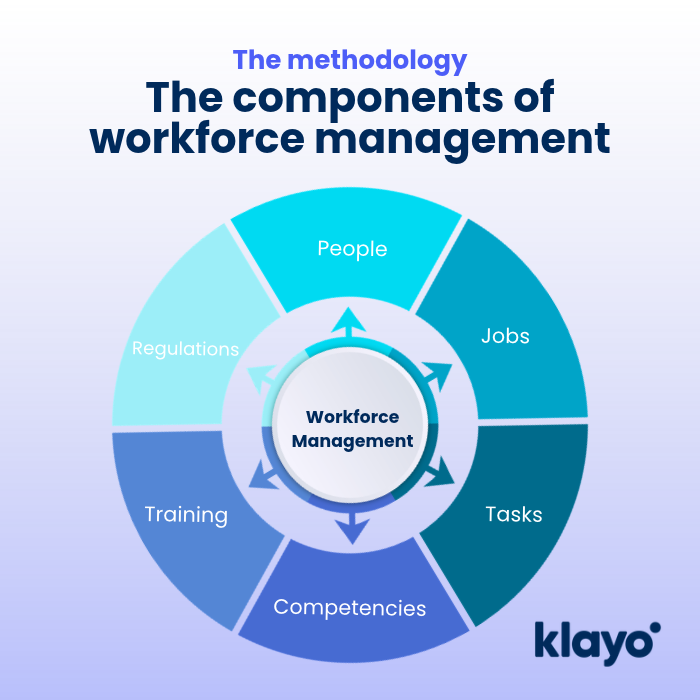
It’s not the job so much we’re really interested in, it’s understanding the tasks that people do within their job. Task analysis and competency mapping close that gap and starting there keeps each course connected to the work a person actually does.
It’s not the job so much we’re really interested in, it’s understanding the tasks that people do within their job.
Regulations can then map onto the same structure, which suits an industry where compliance sits alongside capability.
Where to start
To define a role in a form people can be trained and assessed against, our recent white paper Building a successful airport training plan offers a practical checklist:
- Gather what exists: Job descriptions, procedures, and regulatory requirements show what the role already involves.
- List the tasks: Write each one as an observable action that starts with a verb.
- Note the competencies": For each task, record the knowledge, practical skills, and credentials it depends on.
- Check with the team: Review the draft with the people who do the work.
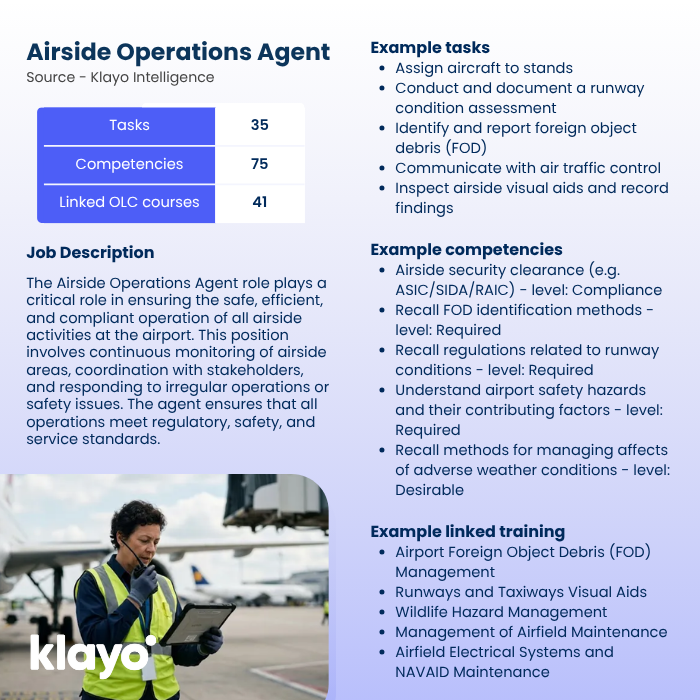
For example, the industry-standard profile for an Airside Operations Agent lists 35 tasks, and 75 competencies and a task such as “conduct and document a runway condition assessment”, for example. draws on knowledge of reporting regulations, the practical skill of the inspection, and the airside driving authorization needed to reach the runway.
Engaging the people in the roles
Top-down workforce management has limited success without engaging the employee and employee engagement in this process is paramount.
Individuals who can access a personal profile where they see their competencies, then are able and empowered to take responsibility for gaps, as well as develop, collect, and showcase their skills.
At an organizational level, it is critical for team leaders to be able to access that information at all levels from the individual to the team or the division in order to make planning effective. After all, you can only close the gaps you can see.
Bringing it together
Once tasks, competencies, and training sit in one structure, gaps become visible at each level:
- An individual sees which competencies their role requires and where they stand against each one.
- A team leader sees where the gaps sit across the team, at task, competency, or training level.
- A department or whole organization sees the same picture for a larger group.
Without one structure, this information can sit in spreadsheets and filing cabinets, spread across departments, each with their own version of what truth looks like.
An accurate industry-standard role profile accessible by all, on the other hand, gives an airport a starting point to define and agree on the tasks, competencies, and training related to a specific role.
Starting from the actual work gives everyone a shared reference point and helps planning training that is meaningful both to the individual and the reality of an airport operations.